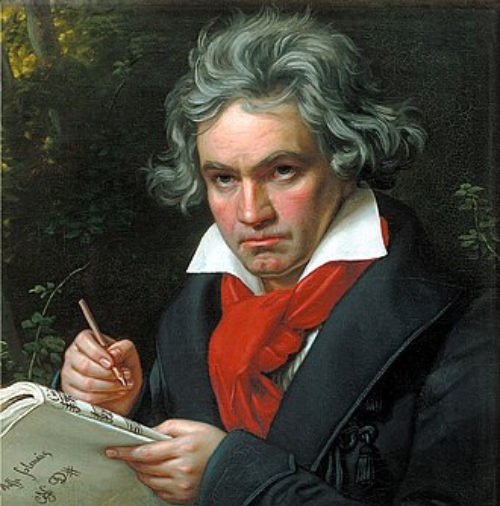
In November 1792, a 21-year-old court musician departed Bonn for Vienna, carrying a farewell album from his friends. One entry, from his patron Count Ferdinand Waldstein, encouraged him to inherit the spirit of Mozart through Haydn. Ludwig van Beethoven studied with Haydn, albeit briefly and not always harmoniously. Over the next 35 years, he changed what a symphony, a sonata, and a string quartet could be asked to say.
Most people can hum two of his ideas without trying: the four notes that open the Fifth Symphony and the melody of the Ode to Joy. Behind these familiar works lies a career marked by exceptional determination. He composed his most ambitious music while gradually losing his hearing, revised his works extensively, and left behind sketchbooks that document the evolution of his ideas over many years.
| Born | Bonn, Electorate of Cologne; baptized 17 December 1770 (exact birth date unrecorded) |
|---|---|
| Died | Vienna, 26 March 1827, aged 56 |
| Musical era | Late Classical into early Romantic |
| Teachers | Christian Gottlob Neefe in Bonn; Joseph Haydn, Johann Georg Albrechtsberger, and Antonio Salieri in Vienna |
| Principal works | Nine symphonies, the opera Fidelio, five piano concertos, the Violin Concerto, 32 piano sonatas, 16 string quartets and the Grosse Fuge, the Missa solemnis |
| Home city | Vienna, from 1792 until his death |
| Resting place | Zentralfriedhof (Central Cemetery), Vienna |
Beethoven was born into a family of professional musicians at the court of the Elector of Cologne, whose capital was Bonn. His grandfather and namesake, a singer from Mechelen in present-day Belgium, rose to become the court’s Kapellmeister. His father, Johann, was a court tenor whose drinking worsened over the years and who pushed his son hard at the keyboard, hoping for a prodigy in the Mozart mold.
The decisive influence was not Johann but Christian Gottlob Neefe, the court organist, who introduced the boy to Bach’s Well-Tempered Clavier and helped him publish his first work, a set of keyboard variations, in 1782. By his teens, Beethoven was playing viola in the court orchestra and deputizing at the organ. A first visit to Vienna in 1787 was cut short when he was called home to his dying mother, Maria Magdalena. Within two years he had effectively become head of the household, taking responsibility for his younger brothers.
Beethoven settled in Vienna in November 1792 and never returned to Bonn. He took lessons from Haydn, then counterpoint with Johann Georg Albrechtsberger and vocal setting with Antonio Salieri. His reputation was made first as a pianist, especially as an improviser, in the salons of aristocratic patrons such as Prince Karl Lichnowsky. His three Piano Trios, published as Opus 1 in 1795, were a deliberate debut as a composer.
By the late 1790s, Beethoven knew something was wrong with his ears. In October 1802, during a summer and fall spent in the village of Heiligenstadt outside Vienna, he wrote a long letter to his brothers describing his despair, his withdrawal from society, and his resolve to keep working. Never sent, it was found among his papers after his death and is known as the Heiligenstadt Testament.
The years that followed were the most productive of his life. Between 1803 and 1812 came the Eroica and the next five symphonies, the Violin Concerto, the Fourth and Fifth Piano Concertos, the Razumovsky quartets, and the opera that became Fidelio. In 1809, when Beethoven was tempted by a post at the court of Jérôme Bonaparte in Kassel, three patrons, Archduke Rudolph and Princes Lobkowitz and Kinsky, guaranteed him an annual stipend on condition that he stay in Vienna.
The decade after 1812 was harder. Beethoven’s hearing declined toward near-total deafness, and from around 1818 visitors communicated with him by writing in notebooks. After his brother Carl died in 1815, he fought a long legal battle with his sister-in-law for guardianship of his nephew Karl, a struggle that consumed years of energy and ended badly for everyone involved.
Out of this came the music of his final decade: the Hammerklavier Sonata, the Diabelli Variations, the Missa solemnis, the Ninth Symphony, and the late string quartets. He died in Vienna on 26 March 1827 after months of illness. Estimates of the crowd at his funeral three days later range from 10,000 to 30,000. Franz Schubert, who would die the following year, was among the torchbearers.
Contemporaries described Beethoven as a man of contradictions. He was often suspicious, quick to quarrel, and disorganized in his personal life, leading to conflicts with landlords, servants, publishers, and friends. However, he was also capable of warmth, loyalty, and wit, as evidenced by the puns and playful tone in his correspondence. Enlightenment ideals of liberty and human dignity are evident in works such as the Eroica and Fidelio, reflecting how his personal convictions shaped the narratives and emotional intensity of his music.
Beethoven’s compositional process was characterized by patience rather than spontaneity. He frequently took long walks in the countryside surrounding Vienna, carrying a sketchbook to record musical ideas. Thousands of surviving sketches reveal themes that were developed, revised, and reconstructed over extended periods.
Beethoven kept the forms he inherited from Haydn and Mozart and changed what they could hold. The first movement of the Eroica alone runs longer than some complete symphonies by either composer. The Fifth carries its opening rhythm through all four movements and breaks from C minor into C major without a pause. The Ninth brings voices into the symphony. In the piano sonatas, he wrote for instruments that were growing in range and power, and asked more of them than they could comfortably give.
Beethoven called it a sonata quasi una fantasia and dedicated it to his young pupil, Countess Giulietta Guicciardi. The name Moonlight is traced to the poet and critic Ludwig Rellstab, whose comparison of the music to moonlight on Lake Lucerne caught on after Beethoven’s death. The famous first movement is a slow, veiled meditation rather than a conventional sonata opening, and the work saves its real storm for a furious finale.
This symphony is frequently identified as the starting point of the 19th-century symphonic tradition. Its second movement is a funeral march, the scherzo features three horns, and the finale is a set of variations on a theme previously used in Beethoven’s ballet The Creatures of Prometheus.
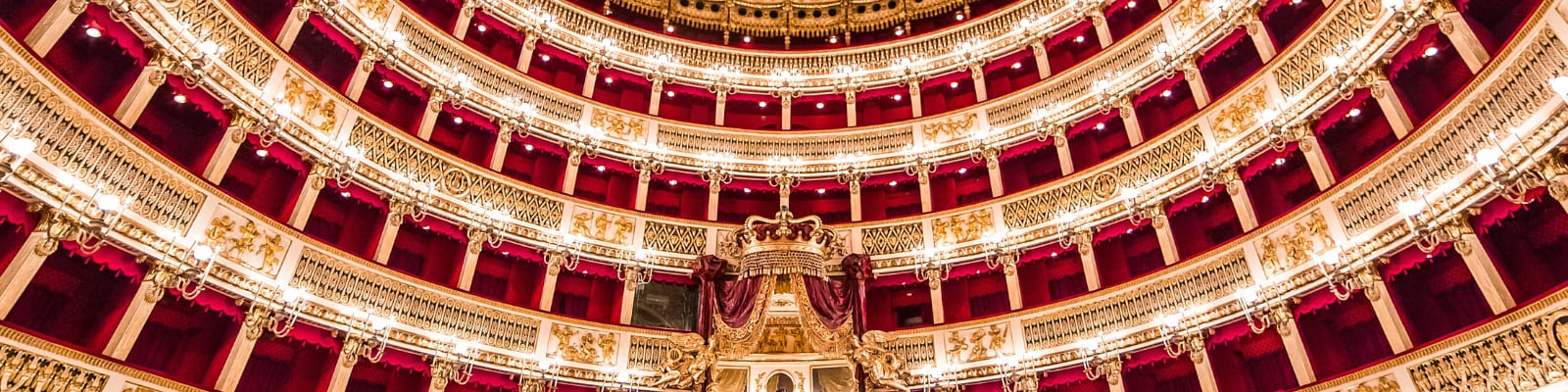
Beethoven’s only opera cost him more labor than almost anything else he wrote. Its first version, now usually called Leonore, opened at the Theater an der Wien on 20 November 1805, a week after French troops had entered Vienna, and played to a thin house. He revised it in 1806 and again, thoroughly, for a successful production at the Kärntnertortheater in 1814. The story of a wife who disguises herself as a young man and takes work as the jailer’s assistant to free her husband from a political dungeon gave Beethoven his great themes of fidelity and liberty. The Prisoners’ Chorus, as the inmates are briefly let into the light, is one of the most moving scenes in opera. Four overtures survive, three titled Leonore and one Fidelio.
Intended for the enthronement of Archduke Rudolph as Archbishop of Olmütz in 1820, the Mass was completed three years later. Beethoven regarded it as one of his greatest accomplishments and inscribed above the Kyrie a wish that what came from the heart might return to the heart. The Agnus Dei, disrupted by military drums and trumpets, transforms a prayer for peace into an urgent plea.
Premiered at the Kärntnertortheater on 7 May 1824, the Ninth Symphony introduces soloists and chorus in its finale, setting Schiller’s poem on universal brotherhood. By this time, Beethoven was nearly completely deaf and stood on stage beside conductor Michael Umlauf, indicating tempos. The Ode to Joy melody now serves as the anthem for both the Council of Europe and the European Union.
Composed after the Ninth Symphony, primarily for private performance, these quartets were long regarded as challenging. Op. 132 features a slow movement titled by Beethoven as a holy song of thanksgiving from a convalescent, written after a serious illness in 1825 and utilizing the Lydian mode. Beethoven’s final completed work was the replacement finale for Op. 130, composed in late 1826 after his publisher requested that the original fugal finale be published separately as the Grosse Fuge.
The erased dedication. Beethoven’s pupil Ferdinand Ries recalled that the Third Symphony was meant to honor Napoleon, and that Beethoven tore up the title page in fury upon hearing, in 1804, that Napoleon had proclaimed himself emperor. The surviving evidence tells a more complicated story. On a copyist’s score now in the archive of the Gesellschaft der Musikfreunde in Vienna, the words naming Bonaparte were scraped away so forcefully that they left a hole in the paper. Yet Beethoven later added a note on the same page that the work was written on Bonaparte. When the symphony was published in 1806, its subtitle dedicated it to the memory of a great man.
The Immortal Beloved. After Beethoven’s death, a passionate, unsent letter was found among his papers, addressed to an unnamed woman he called his Immortal Beloved. It was written on 6 and 7 July 1812, during a stay at the Bohemian spa of Teplitz (Teplice). Scholars have argued over her identity for two centuries. Most now favor one of two women: Antonie Brentano, the candidate argued for by the biographer Maynard Solomon, or Josephine Brunsvik, whom several more recent researchers consider likelier. The question remains open.
The forged conversation books. Of Beethoven’s conversation books, 139 survive. His early biographer Anton Schindler, who kept them after Beethoven’s death, filled blank pages with fabricated entries of his own. The forgeries were exposed in 1977, and several cherished Beethoven anecdotes have been doubted ever since.
Answers in his hair. In the Heiligenstadt Testament, Beethoven asked that his illness be described after his death. In 2023, an international team publishing in Current Biology sequenced his genome from authenticated locks of his hair. They found a strong genetic predisposition to liver disease and a hepatitis B infection, which together with his drinking plausibly explain the illness that killed him. The cause of his deafness remains unknown.
Beethoven’s story can still be followed on the ground, and most of it lies within a short journey of central Vienna.
In Bonn, the house at Bonngasse 20 where he was born has been cared for since 1889 by the Beethoven-Haus association as a museum and research center. Its collection includes the ear trumpets he used as his hearing failed.
In Vienna, where he moved house several dozen times, three places stand out. The Pasqualati House on the Mölker Bastei was his home on and off between 1804 and 1815. The Theater an der Wien, still an opera house, saw the first performances of Fidelio and several of his symphonies. In Heiligenstadt, then a spa village among vineyards, his 1802 lodgings at Probusgasse 6, where he wrote the Heiligenstadt Testament, now house the Wien Museum’s Beethoven Museum.
Summers took him farther out: to the spa town of Baden, where he spent around 15 summers and wrote much of the Ninth Symphony between 1821 and 1823, and to Teplitz in Bohemia, now Teplice, in 1811 and 1812. He lies in a grave of honor at Vienna’s Zentralfriedhof, near Schubert and Brahms.
For the composers who came after him, Beethoven was both an inheritance and a burden. Johannes Brahms labored for roughly two decades over his First Symphony, aware of the comparison it would invite. When listeners noticed that its finale theme resembled the Ode to Joy, he is said to have replied that any fool could see that.
Richard Wagner argued that the Ninth, by bringing words into the symphony, pointed the way toward his own music drama. In 1870, he published an essay on Beethoven, and on 22 May 1872, his birthday, he conducted the Ninth at the Margravial Opera House in Bayreuth to mark the laying of the foundation stone of the Festspielhaus. When the Bayreuth Festival reopened in 1951 after the Second World War, it was again with the Ninth, under Wilhelm Furtwängler. Opera lovers who travel to Bayreuth for Wagner are, in a real sense, visiting a house built on Beethoven’s foundations.
Beethoven’s influence extended beyond individual composers. He contributed to the conception of the composer as an independent artist addressing future generations, rather than as a servant producing music for immediate courtly needs. His symphonies became central to the concert repertoire as the modern orchestral concert emerged in the 19th century. The choral symphonies of Mahler, the expansive finales of Bruckner, and the string quartets of Bartók and Shostakovich all reflect his enduring impact.
Beethoven became almost totally deaf in his final years, but the loss was gradual. He noticed problems in the late 1790s, described them in letters by 1801, and from around 1818 relied on conversation books for everyday exchanges. The cause is still unknown, and the 2023 genome study found no clear genetic explanation.
Beethoven completed nine symphonies between 1800 and 1824. He left sketches for a tenth, but not enough to establish what the finished work would have been.
Yes, one: Fidelio. It exists in three versions. The two staged in 1805 and 1806 are now usually called Leonore; the final version of 1814 is Fidelio. Beethoven also wrote four overtures for it.
No one knows for certain. The letter, written in July 1812 and never sent, names no one. Most scholars favor either Antonie Brentano or Josephine Brunsvik, and both have strong advocates.
His birthplace in Bonn is a museum. In Vienna, the Wien Museum maintains his apartment in the Pasqualati House and the Beethoven Museum at his former lodgings in Heiligenstadt. The Beethovenhaus in Baden also preserves rooms where he lived. Opening times change, so check each museum before visiting.
Beethoven’s music travels perfectly well on its own. Yet something shifts when you stand in the low rooms at Probusgasse, where a 31-year-old wrote to his brothers about the silence closing in, and then walk out into the vineyards he crossed every day. Or when you hear the Prisoners’ Chorus at the Theater an der Wien, the house where the first Fidelio opened to a city newly occupied by Napoleon’s army.
Apart from his youth in Bonn, nearly all the places that shaped his life lie within a short journey of central Vienna. Their streets, theaters, and hillsides are still there, and so is the music he wrote among them. Listening to it in those places is one of the quieter pleasures of musical travel, and one of the most lasting.